
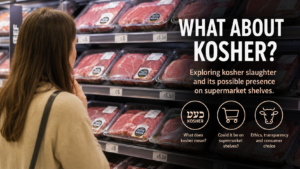
I am active in a number of Facebook groups relating to food. There is a lot of talk about halal, and a question that often arises is “What about kosher?”. When someone asks this question I often take a look at the poster’s profile or other posts and the question is asked, mostly, by two groups of people: those with anti-Jewish sentiment and others (especially muslims) who are trying to deflect away from discussions about halal.
When people say halal most people mean all religious slaughter. It is only recently that people have become more aware of kosher slaughter as, unlike halal, kosher is not commonly mentioned in supermarkets, restaurants or takeaways.
So a common response to the question about kosher is “you won’t find kosher in supermarkets or in takeaways” or “we are not having kosher forced on us”. These answers are far from the truth, and in this post I hope to clear up some misconceptions about kosher.
What is Kosher?
Kosher is the Jewish equivalent of halal for Muslims. Kosher is the word used to indicate that a food item is permissible for a Jew to eat. Colloquially, we have used used the word “kosher” to mean something is OK or genuine. But when it comes to eating meat and poultry, kosher is very much not OK. For meat or poultry to be kosher it needs to be religiously slaughtered using Shechita. Shechita is a non-stun slaughter method, so all kosher meat and poultry is non stun. It is equivalent to non-stun halal, and many Muslims will find kosher meat acceptable.
I won’t find kosher meat in the supermarkets – not true!
To explain why you might be eating kosher meat, we must first understand slaughter processes. This relates to both kosher (shechita) and halal (zabiha/dhabihah).
Consider a slaughter house or cutting plant (which splits carcasses into smaller cuts) that processes kosher or halal meat. Sometimes the slaughterman will reject a whole carcass as not kosher. Rejection in kosher is common as kosher requires animals to be bruise free and the internal organs to be free from lesions or adhesions (sirchot). These defects are only found after the animal is killed. The rejected carcasses may make their way into the general meat market unlabelled.
The accepted carcasses will then make their way to cutting plants, either on the same processing site or elsewhere. This is why meat and poultry packaging can have two codes, one for slaughter and one for cutting.
In both kosher and halal, there are rejections at the cutting stage. For kosher, all rear portions of meat are rejected. These are quite large sections of the animal and they may make their way into the general meat market unlabelled.
It is worth noting that some rejected kosher meat makes it’s way into the halal market, as Muslims are permitted to eat the blemished and the rear ends of kosher slaughtered animals. There are no statistics for how much goes to halal and how much goes to the general meat market.
Then there is simple supply and demand. For example, religious festivals require extra slaughtering of animals, but only particular cuts (maybe a lamb shoulder or leg) are required in large numbers. The rest of the meat may go into the general meat market unlabelled. Even outside festivals, there will be cuts of kosher (and halal) meat that are in less demand and these will go into the general meat market unlabelled. I think you probably get the idea by now. In addition to this, there are dedicated halal slaughter and cutting plants that supply the general meat market by supplying restaurants, takeaways, hospitals, prisons, school meal preparation companies, armed forces.
This leads to one important distinction between kosher and halal. All animals killed in the UK for kosher are, at the point of slaughter, intended for Jewish consumption. This is not true for halal. The majority of halal slaughtered in the UK is not consumed by Muslims (even non-stunned halal makes it’s way to restaurants and takeaways): a shocking fact that is rarely mentioned, and one that surprises most people. Further, what about the vast quantity of imported halal meat and poultry whose provenance is unknown?
Despite the openly public concern, including newspaper articles, about religious slaughtered meat making it’s way onto supermarket shelves, no supermarket chain has made a clear statement denying it. On the contrary, two supermarkets have ambiguously indicated that it does happen, but have not qualified whether non-stun products are reaching the shelves.
So to conclude, kosher meat does make it’s way onto supermarket shelves unlabelled. I would like to surmise that supermarkets that claim that all their meat is stunned are actually hiding the fact that kosher meat, especially beef, is on their shelves. Given the secrecy in the food industry it might take a while before we know the truth. I would like to be proven wrong, but where else is the rejected meat going. Prime cuts of meat are not going to become pet food.
Legality
A few points about what the current UK law says about religious slaughter.
- It is not illegal for someone to sell halal or kosher to non-Muslims or non-Jews. This is why we see chains such as Subways and KFC happily selling halal.
- It is illegal for someone to state that a product is kosher or halal when it is not.
- It is not illegal to say something is non-halal or non-kosher when it actually is. Meat or poultry can stop being certified halal or kosher simply by incorrect transport, having pork or alcohol in the same kitchen, even when the animal was religiously slaughtered. Read the post But they say it’s not halal.
- It is illegal to slaughter an animal using a religious exemption knowing that the intended market is neither Muslim or Jew. This law has never been enforced.
- The UK legal requirement to stun animals prior to slaughter was first introduced in the Slaughter of Animals Act 1933. Religious exemptions were made for the Muslim and Jewish communities. In the 1933 the UK population was 40.5 million with 300,000 Jewish (less than 0.75% of the population) and approximately 10,000 Muslims (0.025% i.e. 1/40%). The understanding, at the time the Act was passed, was that meat and poultry slaughtered using the religious exemption would be sold through specialist shops directly to their respective markets. The Act is clearly being abused.
Facts and Figures
It is hard to get specific data regarding kosher (jhatka is never mentioned) and it is often bundled in with halal in published statistics. The few government reports are based on sampling taken over just days or a few weeks at selected slaughter houses and do not represent accurate statistics. There is a total lack of independent statistics regarding UK slaughter and the most commonly quoted statistics (even those used by government) are from reports published by halal bodies which should not be trusted as they have a vested interest. The same can be said for reports by vegetarian, vegan and sectarian bodies. Treat the statistics as indicative rather than actual.
Beef: Kosher 0.8-1%, Halal slaughter 4% (<1.9% non stun)
Lamb: Kosher less than 1%, Halal slaughter 72-75% (30% non stun and growing) but only 20-30% actually consume by Muslims.
Goats: Halal 56% (estimated two thirds is non stun). No statistics for kosher.
Chicken: Halal 22% (estimated <4% non stun). No statistics for kosher.