
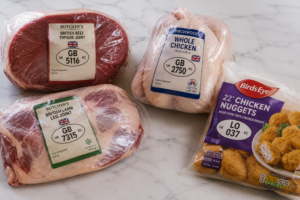
- To be fully clear, food codes do NOT DIRECTLY TELL YOU whether a product is halal, kosher or neither. Read on to find out what the statuses assigned to a particular food code do tell you.
- The statuses given by the food search should be regarded as a risk assessment, i.e. how likely is it that the product is religiously slaughtered.
- The food checker is not suitable for Muslims or Jews to determine whether a product is certified halal or certified kosher or otherwise. Other websites and apps are available.
- Food producers and abattoirs can change suppliers and/or methods at any time. Always consider making your own inquiries of the seller or food producer.
If you are reading this post then it is likely that are intending to type a food code into the checker on the Food Producer Search page in order to find out if a product is religiously slaughtered. This post will explain food codes, how the search determines which status to apply, and how you should interpret the results.
Where to find food codes
Food codes should be printed on all meat and poultry products and are often found inside an oval ring or simply say “Slaughtered in” or “Cut in”. Codes will be a GB or UK followed by 4 digits e.g. 1234, or two letters followed by 3 digits e.g. AB123. If the packaging does not have a code (e.g. loose meat in butchers) you will need to ask for the code; the seller is legally required to know for traceability.
What are food codes?
Each code uniquely identifies a particular abattoir or food producer. This applies, not only to food of UK origin, but also to food imported from other countries. Each country has it’s own coding system. It can often be confusing as codes from other countries can often look like a UK code. Imported products should show a country identifier or specify the country e.g. PL for Poland, NL for the Netherlands, CN for China.
The codes are legally required in order that any meat or poultry food product can be traced back to the originating abattoir or food producer.
As mentioned earlier the UK has two types of code:
1234: 4 digit food codes relate to food producers that are approved by the Food Standards Agency (FSA). The FSA typically approves higher-risk, larger-scale, or specific meat-related establishments. For instance
- Slaughter houses
- Cutting plants
- Wholesale meat
- Cold storage.
AB123: 2 letters and 3 digit food codes relate to establishments approved by a local authority. These are food producers that process products of animal origin for supply to other businesses. For instance,
- Meat processing plants: Producers of meat products, rendered animal fats, greaves, or treated stomachs, bladders, and intestines.
- Minced meat and meat preparation establishments.
- It also includes dairy producers, egg products, fish and shellfish.
Businesses that only sell directly to the final consumer (e.g. a restaurant, butcher shop, or farm shop) do not need approval but do need to register with their local authority.
How do the codes tell you whether the meat or poultry is religiously slaughtered?
Slaughter houses and food producers rarely state publically what their operations entail. Once an establishment has been approved for slaughter they can use any legal means of slaughter including non-stun. There is no legal requirement to declare that religious slaughter exemptions are being used.
DEFRA and other institutions may have knowledge of the slaughter method used in each slaughter house as this information would be gleaned by inspection visits. However, all freedom of information requests have resulted in a refusal to give this information. So unless an establishment makes a public statement, it is more or less impossible to know what slaughter methods are being used.
Some abattoirs and food producers will openly state that they are certified halal or kosher as this is essential information for their sector of the halal or kosher market. Their products are generally clearly labelled halal or kosher. These abattoirs or food producers would be assigned a High Risk status in the checker.
Some abattoirs and food producers will openly state that they are not doing any religious slaughter in order to qualify their credentials for their intended market e.g. organic, ethical standards. These producers would be assigned a Low Risk status in the checker.
This leaves a vast majority of producers that make no statements whatsoever. These remaining food producers are investigated as best we can. For instance, we look for products in supermarkets with certification logos on them linking them to religious slaughter. Sometimes we will find a halal or kosher certification for the producer. In this way, we try to discover the abattoirs and food producers that process religiously slaughtered meat or poultry. These producers would be assigned a Medium Risk, or if the volume of religious slaughter is significant, they may be assigned a High Risk. Such food producers may also process non religiously slaughtered at the same site.
The database includes the three FSA published lists: England and Wales, Scotland and Northern Ireland. The vast majority of producers have a status of Unknown, but many of these will be producers of other food products such as eggs and fish.
Examples
For instance, a chicken nugget producer might make halal-certified nuggets and general market nuggets at the same site. The raw chicken used for the halal market would have to be halal slaughtered. The question is: do the non-halal nuggets use the same halal chicken supplier? If so, then the producer could be selling halal slaughtered chicken without it being labelled as halal. The food producer could, of course, answer this question with a simple clear label but they choose not to. Therefore we can only speculate whether the product is halal. This would be an example of a Medium Risk status. If the food producer is believed to produce significantly more religiously slaughtered product than non-religiously slaughtered product then we might assign a High Risk status.
Similarly, in the case of raw meat, there are instances where a leading supermarket chain has replied to customer enquiries stating that some of their raw meat “may have had a blessing” and sold alongside other meat “in order to avoid food waste”. This is a clear and blatant indication that religiously slaughtered meat and poultry is sold in supermarkets unlabelled. All the major supermarkets state that their meat and poultry comes from stunned slaughter, but this could include recoverable stuns used in religious slaughter. In order to alert consumers that raw meat and poultry originates from abattoirs that use both religious and non-religious slaughter, we assign a Medium or High Risk status. You should also read the article concerning kosher meat and how it can be present in supermarkets unlabelled, and the article But they say it’s not halal.
Finally, if we have found no information at all we assign an Unknown status. We do not make guesses.
Conclusion
Food producers can change suppliers and methods at any time. If in doubt always make your own inquiries.
The statuses given by the food search should be regarded as a risk assessment. We give our assessment of the risk of products being sourced from religiously slaughtered meat or poultry using the information we have.
It is up to you, as the consumer, to consider your own level of risk. Some consumers might take a chance with a Medium Risk status, others tell me they won’t even eat pork from a producer that also does religious slaughter so would only consider Low Risk producers. THE CHOICE IS YOURS.