
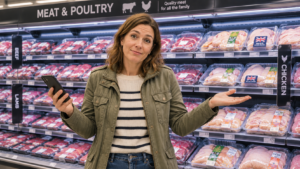
If you ask a supermarket, your local butcher or an online meat supplier whether they sell halal meat or poultry, you will often hear:
“No, we don’t sell halal.”
But what does that actually mean?
In many cases, they may mean that they don’t sell certified halal products — products carrying a logo or certification from one of the many halal certification organisations.
That isn’t necessarily the same thing as saying that the animal was not religiously slaughtered.
So, what’s the problem?
The problem is a lack of clear information.
Some abattoirs process both religiously slaughtered (RS) and non-religiously slaughtered (NRS) animals in the same premises. This means that meat from religiously slaughtered animals can enter the wider supply chain.
What happens to surplus, rejected or unwanted religiously slaughtered meat?
It may still be sold rather than thrown away. If it subsequently enters the general meat supply chain, consumers may have no easy way of knowing how the animal was slaughtered.
There are also questions about meat coming from abattoirs where all animals are religiously slaughtered. Where there is no clear labelling, how is a shopper supposed to know where their meat came from or how the animal was slaughtered?
This is the heart of the problem:
Consumers cannot make an informed choice if the information isn’t available.
“But surely the shop knows?”
You might think that simply asking your supermarket or butcher would give you the answer.
Unfortunately, it may not be that straightforward.
A member of staff serving you may genuinely not know whether the meat they are selling came from an abattoir where religious slaughter takes place. Don’t blame the person behind the counter — they may never have been given the information themselves.
So instead of simply asking:
“Is this halal?”
try asking a more specific question:
“Do you sell any meat or poultry that has been religiously slaughtered? And can you confirm whether the animal was given an irrecoverable stun (rendered permanently unconscious) before slaughter?”
You can also ask:
“Which abattoir was this meat or poultry slaughtered at?”
Once you have the name of the abattoir, you can check it against information available through our Food Producer Search.
Why does the label matter?
This shouldn’t have to be a detective exercise.
Meat and poultry are required to be traceable through the food supply chain, including back to their source. Yet knowing where a product came from is not necessarily the same as knowing how the animal was slaughtered.
For consumers who care about animal welfare, that distinction matters.
We believe people should be able to walk into a shop, pick up a packet of meat and find the information they need on the label. There are already certification labels on halal and kosher products, we need labels for everyone, not just religious groups.
Consumers shouldn’t have to phone head offices, question shop assistants or investigate the supply chain themselves.
What if they won’t tell me?
Keep asking.
If a supermarket, butcher or other food company cannot or will not provide the information you are looking for, you can let them know that transparency matters to you.
And ultimately, you decide where you spend your money.
If a company doesn’t provide the information you want, you can choose to shop somewhere that does.
Every purchase is a choice. If enough consumers ask for better information — and support businesses that provide it — companies have a reason to listen.
We shouldn’t have to guess what happened to an animal before its meat reached our shopping basket.
We should be told.
Want to know more?
Read Selina Scott’s article in the Daily Mail about religious slaughter and the questions surrounding transparency in the meat supply chain.