
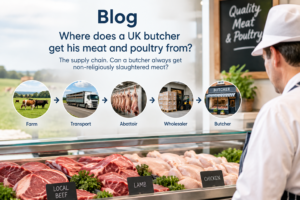
Where Does Your Local Butcher Get Their Meat?
Have you ever stood at the counter of your local butcher, admiring a juicy ribeye steak or a row of plump sausages, and wondered: How did this actually get here?
In a food marketplace dominated by faceless supermarket chains, the traditional high-street butcher hangs by a thread as a source of transparency and quality. But their meat doesn’t just magically appear. It travels through a highly regulated supply chain designed to bring the best of (hopefully) British farming right to your dinner plate.
The Three Paths to the Counter
Unlike supermarkets, which buy in astronomical volumes and lock farmers into rigid contracts, independent butchers have the flexibility to source their meat in a few different ways. Generally, they use one of three main routes:
- Local Farms: This is the ultimate “farm-to-fork” connection. Many premium craft butchers partner directly with farmers in their region. The butcher might even visit the farm to select specific livestock breeds (like Hereford cattle or Hampshire pigs). This keeps food miles exceptionally low and ensures maximum transparency.
- Direct from the Abattoir: To maintain freshness and select the exact grade of meat they need, many traditional butchers bypass middle-men entirely and establish direct relationships with local, licensed slaughterhouses (abattoirs).
- The Wholesale Market: Just like London’s famous historic Smithfield Market, regional wholesale hubs allow butchers to buy specific parts of an animal according to demand. Wholesale markets are often the source of imported meat and poultry.
The Step-by-Step Journey: From Field to Fork
Every single cut of meat sold legally by a UK butcher follows a strict, safe, and highly traceable four-step journey.
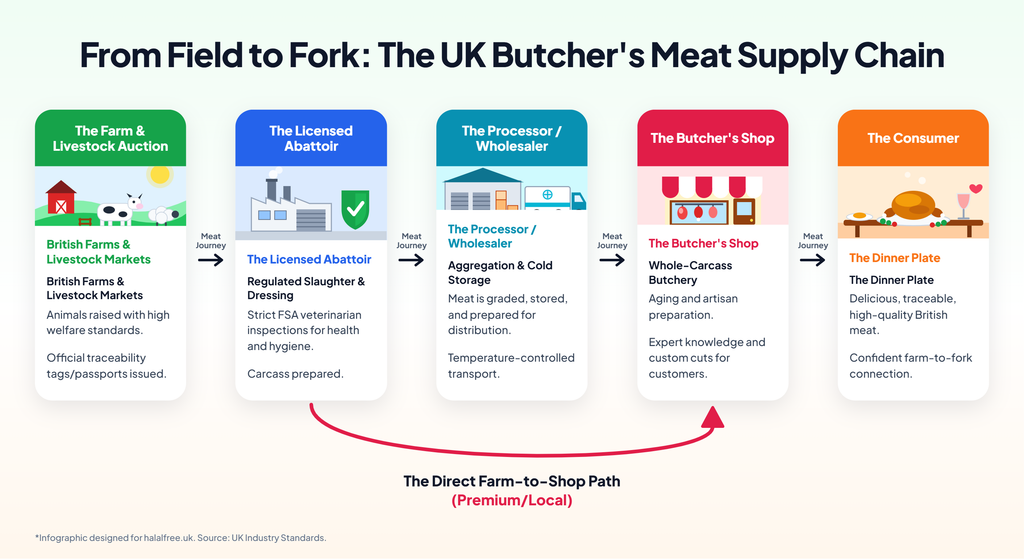
1. The Farm & The Passport
It all begins on the farm. British livestock farming operates under some of the highest welfare standards in the world. What many people don’t know is that every cow in the UK has its own official passport! This document tracks the animal’s entire life: where it was born, every farm it has moved to, and its medical history. This ensures complete traceability; if you ask your butcher exactly which farm your steak came from, they can often tell you the exact name and location. Traceability in other livestock is less strict. Farmers sell their livestock either directly to abattoir procurement agents or via local livestock auctions, where butchers and wholesalers bid on live animals.
2. The Licensed Abattoir
When livestock is ready, it is transported to a regulated regional abattoir. Food safety in the UK is incredibly strict. Independent veterinarians from the government’s Food Standards Agency (FSA) inspect the animals both before and immediately after slaughter. They ensure the animal was healthy, treated humanely, and that the meat is perfectly safe for human consumption.
3. The Cold Chain
Once the carcass is dressed (cleaned and prepared), it enters the “cold chain.” Meat must be chilled immediately and kept under strict temperature controls (usually below 7°C). Ideally, specialized refrigerated transport trucks deliver the meat (whole sides or quarters) directly to the butcher’s cold room, ensuring it never spoils.
4. The Craft of the Butcher
This is where the magic happens. While supermarket meat is often chopped up by automated machines in giant factories and packed with gas to preserve its colour, a traditional butcher relies on artisan skill.
- Ageing: Beef, for instance, is often hung in a dedicated dry-ageing fridge for 21 to 28 days. This natural process allows moisture to evaporate, concentrating the flavour and breaking down connective tissue to make the meat incredibly tender.
- Seam Butchery: Traditional UK butchers practice “whole-animal” or “seam” butchery. They use knives and saws to break down large quarters of meat along the natural muscle seams, minimizing waste and creating custom retail cuts tailored exactly to how you want to cook them.
Why Buying from an Independent Butcher Matters
When you support your local butcher, you aren’t just buying dinner, you are supporting an entire ecosystem. You are backing local British farmers, reducing carbon footprints by cutting out global shipping loops, keeping traditional artisan skills alive, and ensuring that the food on your family’s table is safe, traceable, and delicious.
Next time you’re at the counter, don’t be shy, ask your butcher where the meat came from. They should be proud to tell you the story behind it!
Do Independent Butchers sell Religiously Slaughtered Meat?
Unfortunately some do. Understanding the supply chain described above helps us to see where things go wrong.
If a butcher buys his meat and poultry originating from abattoirs that do not do religious slaughter (RS), then obviously there isn’t going to be any in the shop. This is the ideal situation.
What if the butcher does buy his meat and poultry from abattoirs that do religious slaughter? Depending on location, some butchers will genuinely find it hard to acquire produce from purely non-RS abattoirs. However, many abattoirs that do RS, also do non-RS so the butcher may have a choice. The reasons a butcher would buy RS meat and poultry are:
- It’s cheaper. RS meat and poultry is rarely true higher welfare or organic. Buying RS meat because it’s cheaper can be the fault of the customer as much as being the fault of the butcher. If the customer wants only cheap produce, then the butcher may have to choose this option. If the butcher is buying from a wholesaler, then imported options are available: beef from Brazil, Australia and Ireland, lamb from New Zealand, and chicken from Thailand, Poland, The Netherlands, and China. Most imported meat and poultry is halal slaughtered. All these imported meats and poultry are commonly found being sold by high street butchers. Remember, the butcher is a business and needs to make a profit. However, if the butcher chooses to buy cheaper RS meat purely to increase their profit, then the blame is entirely theirs.
- Out of necessity (possibly temporarily). Buying RS out of necessity is a more difficult scenario. Sometimes the location of a butcher can mean that it is difficult to obtain non-RS meat and/or poultry. Even butchers who generally sell non-RS chicken often complain that, at times, they have to sell RS chicken because non-RS supplies are low. These are issues with the supply chain, but I do question whether butchers could make a greater effort to obtain non-RS produce.
- Unknowingly. Buying RS unknowingly is unforgiveable; a butcher should know the provenance of his meat and poultry, and be happy to share that information with the customer. However, some butchers have claimed that they had no idea that they were selling RS produce. Suppliers will not necessarily tell the butcher if slaughter methods have changed, or give deliberately vague information.